The Medicaid Strategy Most Dentists Ignore
When one of my dental marketing clients told me he wanted to focus on Medicaid patients, I was surprised.
I have been running ads for dental offices since 2018. Almost without exception, every dentist I work with wants to avoid Medicaid and low-income patients entirely.
In many campaigns, dentists ask the opposite question:
"How do we prevent Medicaid patients from filling out our ads?"
But this client wanted to go the other direction. Instead of avoiding Medicaid patients, he wanted to actively target them.
So we built an ad campaign specifically designed for Medicaid patients.
The results shocked us.
What we discovered was a true blue ocean market, and the ROI for this dental office skyrocketed.
Let me explain why.
Understanding the Market Size
First, let's look at the size of the Medicaid population.
Approximately 25% of the U.S. population is on Medicaid, which is about 87 million people.
The remaining 75% of the population (around 260 million people) are not on Medicaid.
At first glance, many dentists assume:
- Medicaid is a smaller market
- Patients have lower income
- It isn't worth pursuing
But that logic ignores something critical.
Competition.
The Real Problem: Competition Ratios
According to available estimates, the United States has roughly 140,000 dental offices.
From my experience working with dental practices and running ads:
- About 98% of dental offices avoid Medicaid
- Only about 2% actively target Medicaid patients
Let's break that down.
Dentists Targeting Medicaid
Two percent of 140,000 dental offices equals roughly 3,000 practices targeting Medicaid patients.
Those practices are competing for about 87 million potential patients.
This means each dental office is competing for roughly:
29,000 potential patients per practice
Dentists Targeting Non-Medicaid Patients
The remaining 137,000 dental offices compete for the 260 million non-Medicaid population.
That creates a ratio of roughly:
1,898 potential patients per practice
The 15x Competition Difference
Now look at the difference between these two markets.
29,000 potential patients per office vs 1,898.
This means dentists targeting Medicaid patients are operating in a market that is approximately:
15 times less competitive.
This is the definition of a blue ocean market.
A blue ocean is a business environment where competition is dramatically lower, giving businesses a strategic advantage.
Meanwhile, the traditional dental marketing market is a red ocean, where thousands of dentists compete for the same patients.
What Happened When We Ran the Ads
Once we launched the Medicaid-focused campaign, two major things happened.
Cost Per Lead Dropped
Cost per lead decreased by about 40%.
Before targeting Medicaid Cost per lead: $60
After targeting Medicaid Cost per lead: $36
Conversion Rate Doubled
Even more interesting, the conversion rate from lead to patient doubled.
Before targeting Medicaid Close rate: 15%
After targeting Medicaid Close rate: 30%
Cost Per New Patient
This dramatically changed the cost of acquiring a new patient.
Before targeting Medicaid:
$60 per lead ÷ 15% close rate = $400 cost per new patient
After targeting Medicaid:
$36 per lead ÷ 30% close rate = $120 cost per new patient
That is nearly four times cheaper to acquire a new patient.
"But Medicaid Patients Have Lower Lifetime Value"
This is the most common objection.
And in many cases, it is true. Medicaid patients often generate less revenue per visit.
But what most dentists fail to realize is that the problem isn't the patients.
The problem is the systems inside the practice.
Most dental offices are structured around private insurance and high-ticket procedures. Their workflows, staffing, and scheduling are not designed for Medicaid volume.
The client we worked with built systems specifically around Medicaid patients.
This includes:
- Efficient appointment scheduling
- Cost control per visit
- Optimized treatment workflows
- Higher patient volume
Because of these systems, the practice can generate strong profitability even with lower revenue per visit.
The Long-Term Strategy
This dentist's strategy is actually very similar to how technology companies grow.
Instead of maximizing revenue per patient, the focus is on capturing market share.
His goal is simple:
Dominate the Medicaid patient market in his city.
Once that happens:
- Patient volume increases
- Operational efficiency improves
- Cost per patient continues to decrease
- Practice valuation increases
Some Medicaid patients will also eventually transition to higher-paying treatments as their financial situations improve.
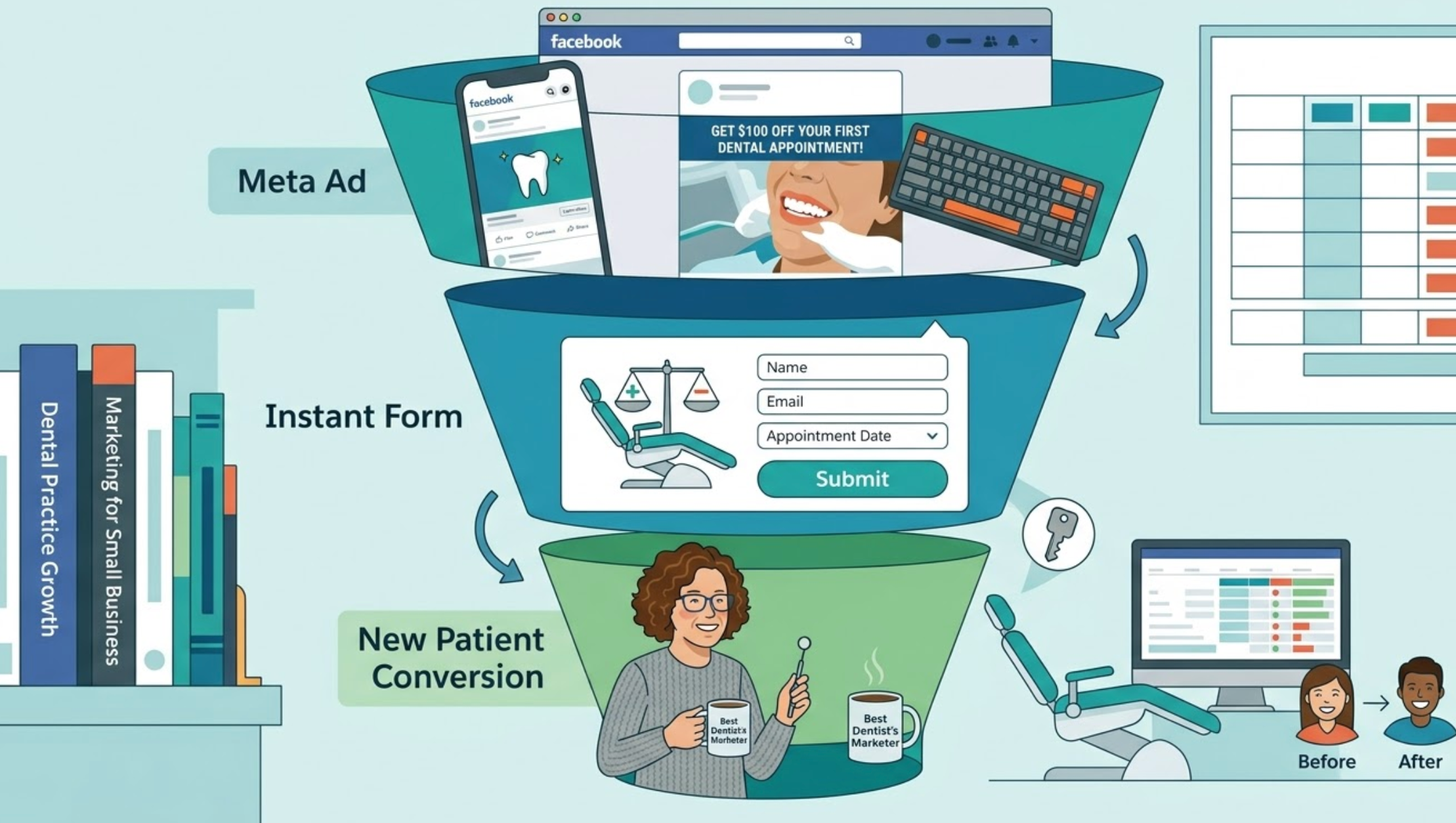
The Simple Funnel Behind the Strategy
The marketing funnel itself is intentionally simple.
Step 1: Google Ads
The ads lead directly with Medicaid messaging.
Examples:
- Medicaid Dentist in [City]
- Affordable Dental Care
This immediately attracts the correct audience.
Step 2: Landing Page
The landing page continues the same messaging.
The above-the-fold section clearly states that the practice accepts Medicaid and specializes in those patients.
This dramatically increases conversion rates.
Step 3: Lead Tracking and Follow-Up
Once the lead is submitted:
- The dental office receives instant email notifications
- The lead is logged into a tracking system
- Staff follow up quickly to book the appointment
The entire funnel is intentionally simple and focused.
The Bigger Lesson for Dental Marketing
This strategy highlights an important lesson.
The best opportunities in marketing often come from looking where others refuse to look.
While most dentists compete for the same private-pay patients, a small number of practices are quietly building dominant positions in less competitive markets.
Sometimes the "lower value" market ends up being the most profitable one of all.