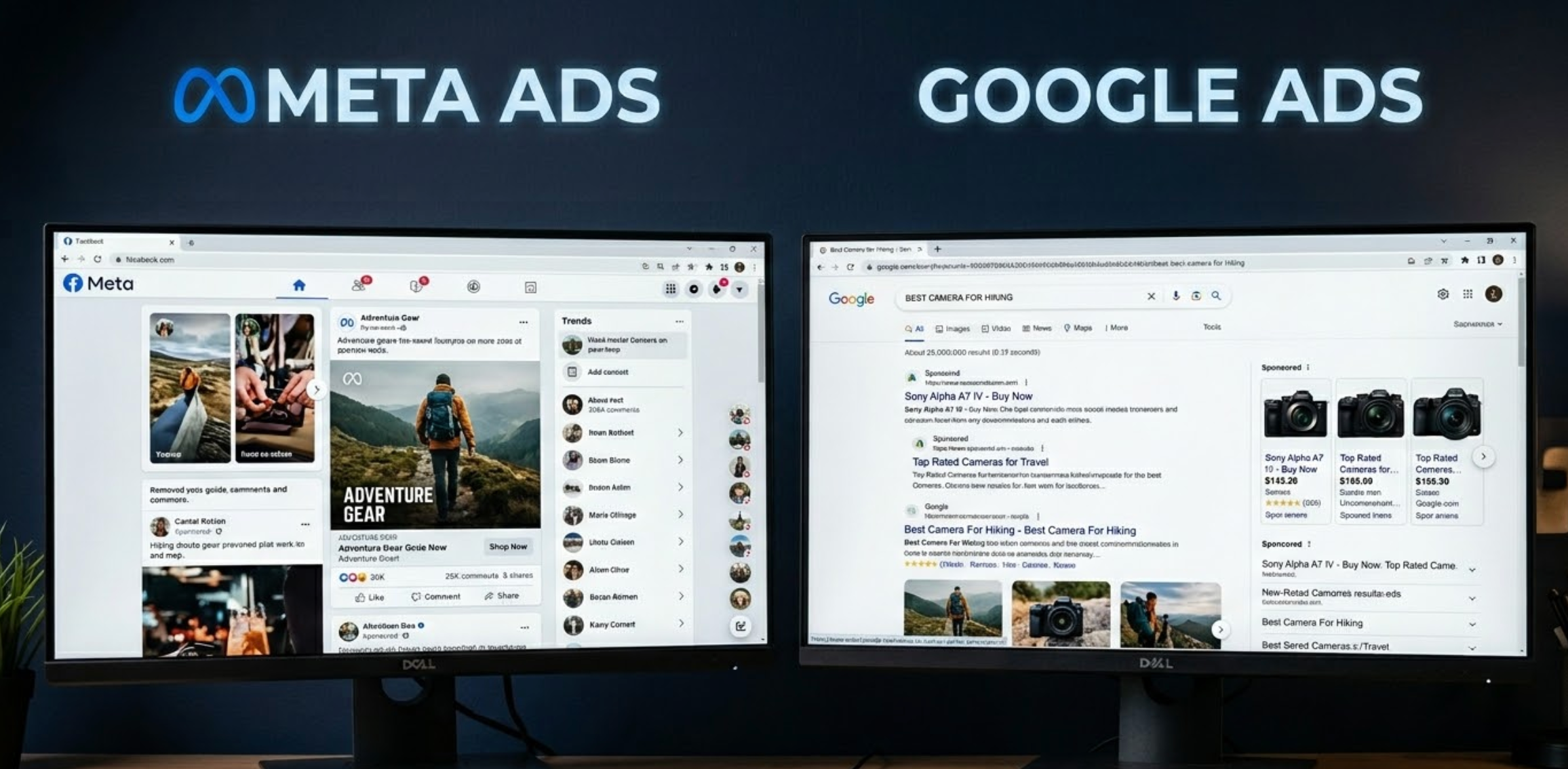
One of the most common questions we get from business owners is: should I run Meta Ads or Google Ads? It sounds like a simple question, but the honest answer is — it depends. And not in a vague, consultant-speak way. There's a real framework for thinking through this decision, and we're going to walk you through all three levels of it.
Level 1: The Standard Pros and Cons
Most marketing blogs stop here — and while this level is useful, it's only the beginning. Let's cover the fundamentals first.
Meta Ads (Facebook & Instagram)
Meta Ads operate on an interruption model. Users aren't searching for your product — they're scrolling through their feed, and your ad appears in front of them. This means you're reaching people before they know they need you.
Key advantages of Meta Ads:
- Massive audience reach across Facebook and Instagram
- Excellent for video content and visual storytelling
- Generally lower cost per lead compared to Google
- Powerful audience targeting based on demographics, interests, and behaviours
- Works well for products or services people didn't know they wanted
The trade-off: because you're interrupting people rather than catching them mid-search, lead quality tends to be lower. You'll generate more leads, but they may require more nurturing before converting.
Google Ads (Search & Display)
Google Ads operate on intent. When someone types "emergency plumber near me" into Google, they are actively looking for a solution right now. Your ad meets them at the exact moment of need.
Key advantages of Google Ads:
- High-intent traffic — users are actively searching for what you offer
- Excellent for niche products and services with specific search demand
- Higher quality leads that are closer to making a purchase decision
- More sophisticated targeting and campaign structure options
- Strong performance for local service businesses
The trade-off: Google Ads typically come with a higher cost per lead and higher cost per click. You're paying a premium for that intent — and in competitive industries, those costs can add up quickly.
Level 2: The Real Heuristic — Boring vs Exciting Businesses
Here's where most marketing advice falls short. The pros-and-cons list is useful, but it doesn't tell you which platform is right for your specific business. The real heuristic comes down to one question: is your business boring or exciting?
This isn't a judgment — it's a strategic distinction.
Boring Businesses → Google Ads
Think: electricians, plumbers, industrial suppliers, cable repair technicians, commercial refrigeration services. These are businesses that solve urgent, functional problems. Nobody is scrolling Instagram hoping to stumble across a great deal on switchboard installation.
The reason boring businesses struggle on Meta comes down to dopamine. Social media platforms are dopamine machines. Users are there for entertainment, connection, and inspiration. When a dry, functional ad for a plumbing service interrupts that experience, the algorithm punishes it — low engagement, poor reach, wasted spend.
Google, on the other hand, is where people go when they have a problem that needs solving right now. That's exactly when boring businesses shine.
Exciting Businesses → Meta Ads
Think: apparel brands, travel companies, experience providers, cosmetic dental clinics, lifestyle products. These businesses sell aspiration, transformation, and desire — exactly the kind of content that thrives in a social feed.
A stunning video of a resort in Bali, a before-and-after dental transformation, a beautifully shot clothing campaign — these ads don't interrupt the social experience. They enhance it. The algorithm rewards high engagement, and exciting businesses naturally generate it.
Meta also allows exciting businesses to reach people who didn't know they wanted something — which is a powerful position to be in when your product creates desire rather than solving an existing problem.
Level 3: The Counterintuitive Insight — Test Both
Here's where it gets interesting — and where most businesses leave money on the table.
The boring vs exciting framework is a strong starting point, but market competition can flip the logic entirely. Think of it like the stock market: if everyone already knows a stock is a good buy, that information is already priced in. The opportunity has been arbitraged away.
The same principle applies to advertising platforms.
The Blue Ocean Opportunity
Imagine you're an electrician in a competitive city. Every other electrician in your market is running Google Ads, driving up the cost per click to painful levels. Meanwhile, almost none of them are running Meta Ads — because conventional wisdom says boring businesses don't belong on social media.
That's a blue ocean. If you can create even a moderately engaging Meta campaign — a quick video showing your team at work, a before-and-after of a switchboard upgrade, a simple testimonial — you may find dramatically lower costs and far less competition than on Google.
Conversely, if you run an exciting business in a saturated Meta market, Google might offer a more cost-effective path to customers who are already ready to buy.
How to Find Out: The $500 Test
The fastest way to answer the Meta vs Google question for your specific business isn't to theorise — it's to test. Here's a simple approach:
- Allocate $500 to Meta Ads for one week
- Allocate $500 to Google Ads for the same week
- Track cost per lead, lead quality, and conversion rate on both
- Double down on whichever platform delivers better results for your business
One week of real data is worth more than months of speculation. The market will tell you where your opportunity is — you just need to listen.
Putting It All Together
To summarise the three-level framework:
- Understand the fundamentals — Meta is interruption-based with lower-cost, lower-quality leads; Google is intent-based with higher-cost, higher-quality leads.
- Apply the boring vs exciting heuristic — boring businesses generally belong on Google; exciting, visual businesses generally belong on Meta.
- Test both platforms — market dynamics can flip the conventional wisdom, and a $500 test on each platform will give you real data faster than any framework.
The businesses that win at paid advertising aren't the ones who pick the "right" platform based on theory — they're the ones who test quickly, read the data honestly, and scale what works.
Ready to Get Started?
If you want to learn how to set up Meta Ads or Google Ads yourself, check out our other videos on the channel — we cover campaign setup, targeting, creative strategy, and more in plain language.
Prefer to have an expert handle it? Book a free strategy call with the North Digital team. We'll look at your business, your market, and your goals — and give you an honest recommendation on where your ad spend should go.