
If you run a clinic, a dental practice, or a trades business, you have written an ad and felt the pull to make the claim a little bigger. Same day service when it is usually next day. Pain free when it is mostly pain free. This week's news shows where that road can end.
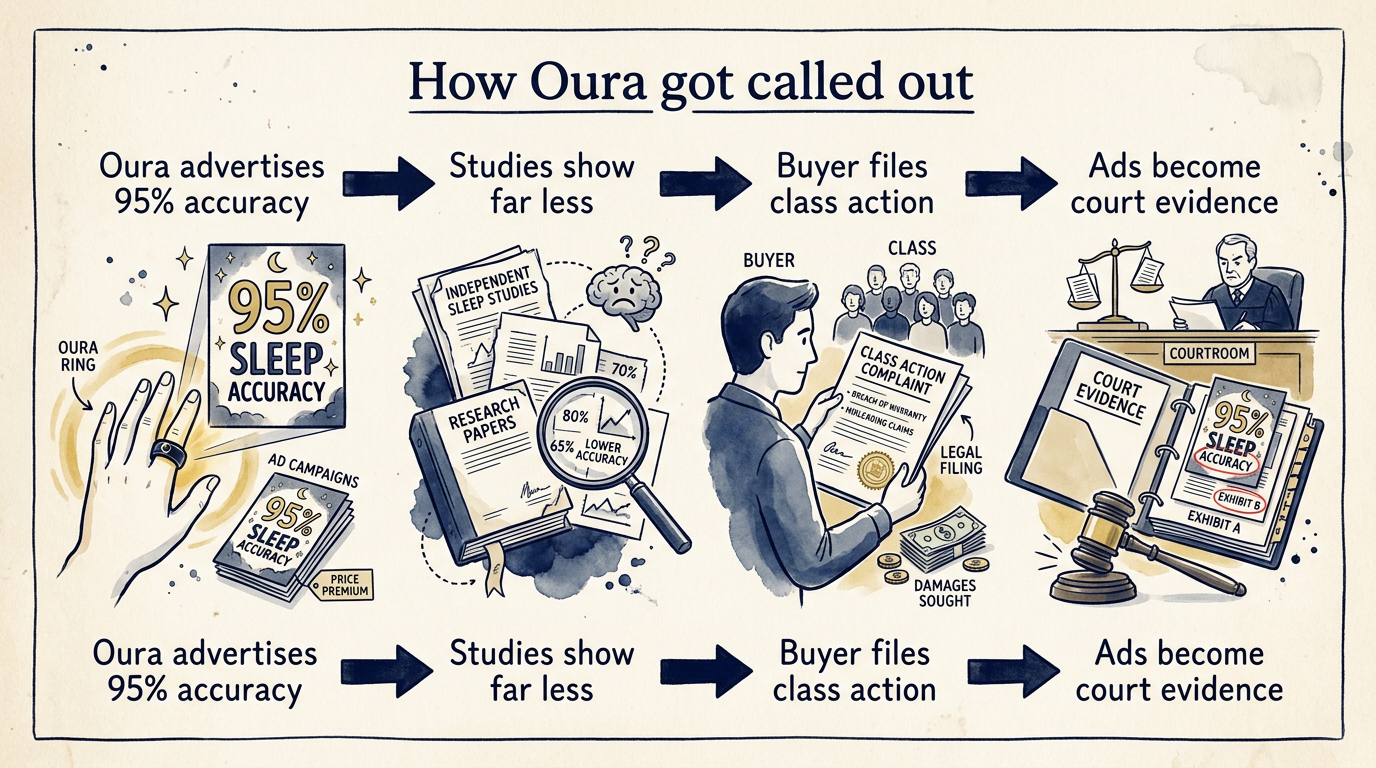
On August 20, 2026, a California buyer filed a proposed class action, a lawsuit brought on behalf of a whole group of purchasers, against Oura, the company that sells a smart ring that tracks your sleep. PPC Land, an advertising trade publication, reported the filing. The complaint centers on one number from Oura's marketing: 95% sleep staging accuracy compared to a clinical sleep lab.
The gap between the ad and the fine print
The plaintiff, Madison Surber, bought an Oura Ring 4 Gold for about $513.68 from the company's website in May 2025. Her lawyers argue the ring cannot deliver what the ads promised because it has no sensors for brain waves, eye movement, muscle tone or cardiac electrical signals. Those are the measurements a real sleep lab uses to identify sleep stages.
The sharpest evidence came from Oura itself. The company's own technical content says using an Oura Ring "is not the same as a PSG (as it does not measure electrical brain activity or eye movements)." PSG is polysomnography, the clinical sleep lab test. The qualification exists, but it lives in blog and support material while the sales page shows the big number.
The numbers stack up badly. The product page says 95%. A 2022 company blog post says 79% agreement with the gold standard. A study published in Nature, a scientific journal, in March 2025 put overall stage classification accuracy at 53.18%.
Why advertisers keep making claims like this
Here is my honest take, and it points at a somewhat disappointing truth about advertising and human nature. When someone clicks your ad, by the time they reach the next step, whether that is a sales call, a lead magnet or a checkout page, they have forgotten what the ad said. People are hit with so many organic and paid messages every day that no single one sticks.
Advertisers know this. So many lead with ridiculous claims, because 99 times out of 100 nobody calls them out. The claim does its job in the two seconds it takes to earn the click, then it fades from memory. The way I see it, this lawsuit is the one time in a hundred. Oura got called out.
The complaint turned ad automation into evidence
One section of the filing reads like an ad operations manual. The lawyers reviewed the ad library of Meta, the company behind Facebook and Instagram, and found roughly 91 ads running for the brand, nearly all using dynamic creative. That is a system that automatically mixes headlines, images and text into personalized versions of an ad. The complaint did the math: four variations of each element produce 1,820 possible combinations.
That matters because the plaintiff cannot point to the exact ad she saw, and the filing turns that into an argument. If the machine built a different version for every viewer, no individual can be expected to remember which one they got, so the message counts as uniform across the whole class. A feature advertisers use for performance became an argument for class-wide deception.
In my experience running Google and Meta accounts for service businesses over the past decade, that detail should give every owner pause. The complaint lists Oura's ad copy with source URLs and access dates. Your claims sit in a public record that anyone, including a lawyer, can pull with timestamps.
Scale did not protect them
Oura is not a small operator. The complaint describes a company valued around $11 billion after a 2025 funding round, with more than 5.5 million rings sold and revenue above $1 billion in 2025. The filing names Jennifer Aniston, Prince Harry and Kim Kardashian among its celebrity adopters. None of that stopped the lawsuit. It made the company a target worth suing.
Your dental practice or HVAC company will probably never face a nationwide class action over an Instagram ad. You can still face a state consumer complaint, a board complaint if you are in healthcare, or a refund fight that damages your reviews. My bet is this style of case keeps spreading, because the article notes the same theory already appeared in recent filings against Mars, the food company, over a rice product, and against a coffee brand over origin imagery. The pattern is always the same: bold claim up front, correction buried where nobody reads it.
I expect the honest version of your offer, stated plainly, to outperform the inflated version over time anyway, because the inflated version creates refund requests and angry calls that the ad platform never shows you.
How Oura got called out
How to prepare your business
1. Pull up every live ad this week and flag any number or superlative you cannot back with a document.
2. Move important qualifications onto the ad and landing page, not a blog post nobody reads.
3. Open your own listing in Meta's Ad Library and save what is running, because anyone else can see it too.
If you want a second set of eyes on the claims in your ad account, book a call with me and we will go through them together.